 Neditek
Buy RF Power Amplifier: A Practical Sourcing Guide
When purchasing RF power amplifiers for laboratories or system integration projects, it is difficult to compare different quotations if the inquiry table only writes "RF power amplifier" and a wattage. The delivery form may be bare die, discrete transistor, matching device, MMIC, power amplifier module, power tray or complete SSPA. The development work, test responsibility and delivery content of each level are different. For teams that need to buy RF power amplifier, the first step is to clarify the product form, output reference surface and acceptance conditions.
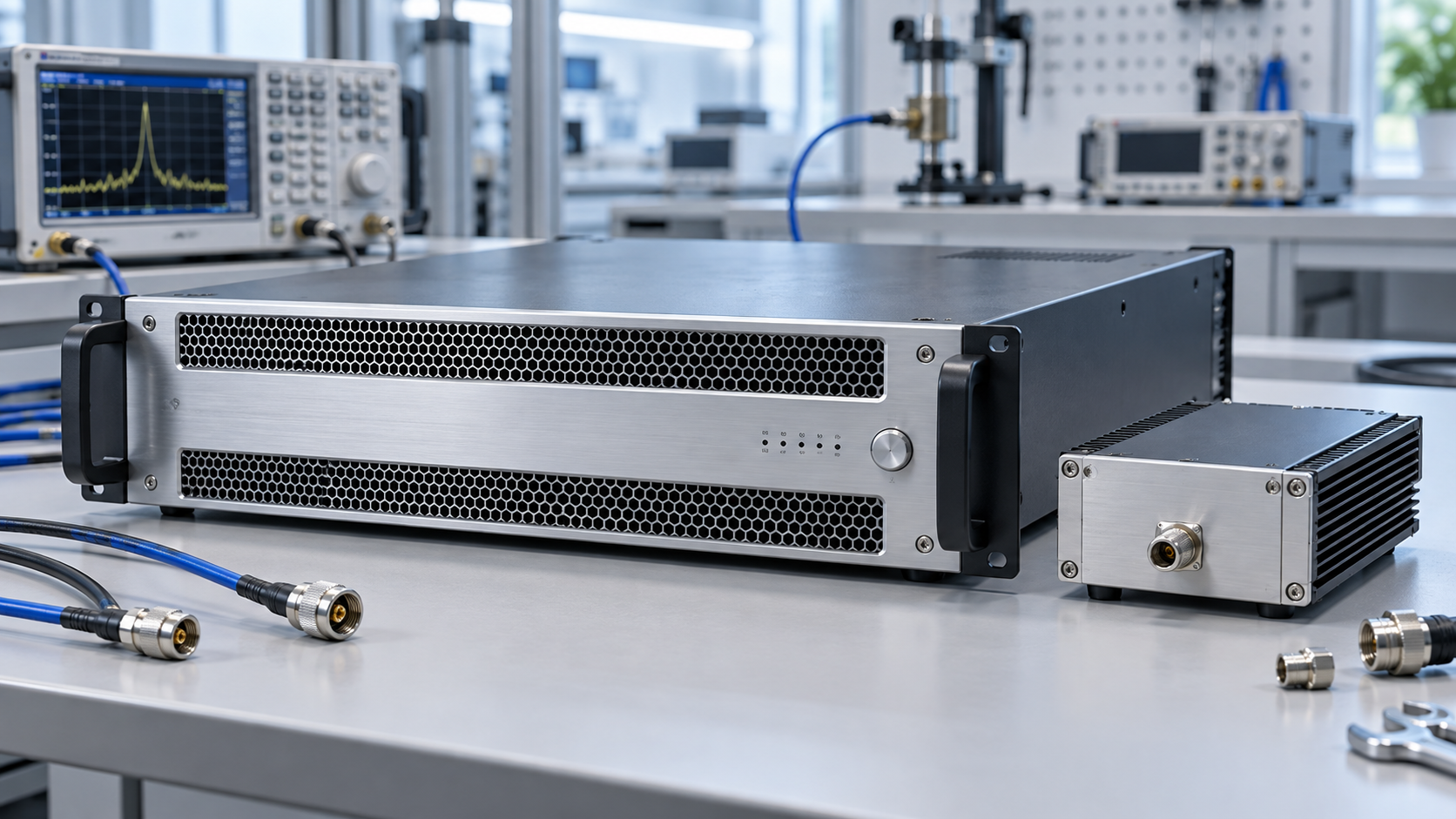
Determine which layer to buy first.
Start by explaining whether the project requires components, modules or complete equipment, and write down what the quotation includes, such as matching boards, evaluation boards, fixtures and cooling components. Record the complete material number, packaging and test responsibilities. Different delivery levels cannot be directly compared based on rated wattage alone.
Put power requirements to the same test condition
Start by listing the application, actual frequency band, instantaneous bandwidth, signal waveform, and output target. The power value also indicates a reference surface, such as a device pad, a module connector, a filter back end, or an antenna end. Losses in cables, isolators, combiners, filters and switches can affect the required output from the front stage, so the same reference position is used for quotation and acceptance.
If the signal is a pulse or modulated waveform, the peak, average, pulse width, or modulation condition should be stated separately; P1dB in CW is not a substitute for modulated waveform verification when 5G modulated signals are involved. Broadband projects should compare the output, gain, echo, efficiency, spurious and stability of the entire frequency band, not just the center frequency point. Also list power supply, linearity requirements, operating temperatures, cooling methods, and packaging requirements.
Request evidence concurrently when making an inquiry.
Allow each supplier to respond to the full item number, suffix, package, temperature class, product status, lifecycle information, and minimum order quantity based on the same version of the specification. Current data sheets, S-parameter or non-linear models, recommended biases, reference designs, thermal models, and large signal test conditions are available prior to sample evaluation. The high power proposal also needs to state whether the fixture, matching plate and cooling system are included in the quotation.
Supply chain roles also need to be clarified. Manufacturers, original factory authorized channels, independent distributors, module integrators and third-party testing service providers bear different responsibilities; inquiry should confirm the original factory relationship, batch traceability, quality system information, technical support scope and problem handling boundaries. If the test is commissioned, the sample results are comparable only if the reference surface, calibration method, uncertainty, frequency and power step, waveform, temperature, cooling, load standing wave and determination rules are agreed in advance.
The South Desai product catalog lists solid-state power amplifiers and solid-state microwave signal generators, and the company's service direction also covers program support from chips, package modules to systems. When inquiring about the specific scheme, you can first provide the frequency band, bandwidth, waveform, output reference surface, power, power supply, cooling and interface requirements, and then check the specific model, effective specifications and delivery scope. Quotation, stock and delivery conditions shall be confirmed by current written information.
The product form, measurement conditions, data version and acceptance method are written into the same requirements document, so that samples, quotations and subsequent batches can be compared according to the same caliber.