 Neditek
600W GaN Power Amplifier 1.2-1.4 GHz or L-Band P1dB
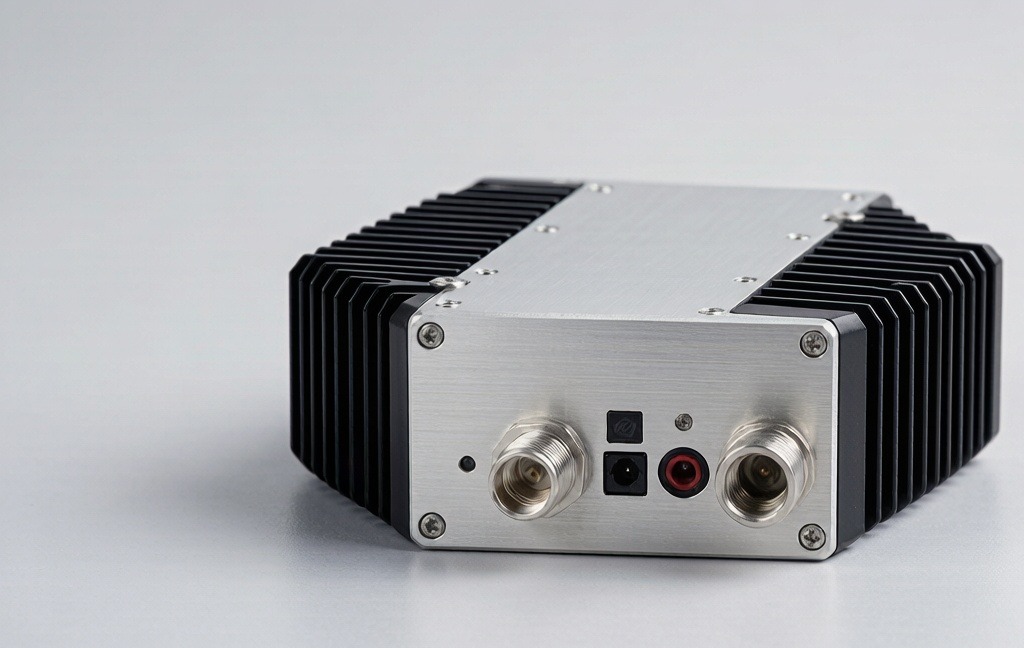
Why 600 W at 1.2-1.4 GHz Needs Its Own Discussion
1.2-1.4 GHz falls in the L-band, a spectrum used by radar, telemetry, satellite uplinks, and a portion of high-power industrial RF systems. A 600 W RF output corresponds to roughly 57.78 dBm, well beyond what small-signal devices can cover, so selection must simultaneously account for the device, matching, power supply, thermal management, and load conditions. More importantly, a 600 W figure alone is incomplete — whether it is measured under CW or pulsed conditions, whether it is peak or average power, and what compression state it sits in all directly determine whether you end up with an amplifier that actually works or a purchase that needs rework. Only by reading the power number together with its underlying test conditions does a 600 W rating become meaningful.
600W RF Power Amplifier 1.2-1.4 GHz GaN: Material and Device Platform
At this frequency band and power level, GaN is nearly the undisputed choice. GaN is a wide-bandgap semiconductor, and when paired with a SiC substrate it offers a short thermal path and high power density — exactly what is needed for high-power amplification in a mid-band like 1.2-1.4 GHz. Compared with GaAs, GaN is better suited to final-stage high power, while GaAs is usually left for driver stages or low-noise positions. A typical GaN HEMT conducts through the two-dimensional electron gas at the AlGaN/GaN heterojunction interface, with the source and drain carrying the main current and the gate voltage modulating the channel. Most of these devices are depletion-mode and conduct near zero gate voltage, so at power-up you must first establish a negative gate voltage before applying the drain voltage; reversing the order can easily destroy the device. A 50 V drain supply is common at this power level, and the accompanying design can often push drain efficiency above 60%, significantly reducing the thermal burden. Several typical examples in the industry serve as references: the MAPC-A4027, a 50 V GaN-on-SiC device rated at 600 W output at 1.2-1.4 GHz under pulsed conditions, with about 14.6 dB typical large-signal gain and about 60% drain efficiency; the GTVA126001EC and GTVA126001FC, which deliver 600 W at 1.4 GHz with a 300 μs pulse width and 10% duty cycle; and the CLL3H0914L-700 and CLL3H0914LS-700, internally pre-matched GaN-on-SiC HEMTs for 1.2-1.4 GHz whose demo-board data is usually measured at 50 V, 500 mA quiescent current, 100 μs pulse width, and 10% duty cycle. All of these figures carry specific test conditions and cannot be used directly as full-band or CW performance.
600W RF Power Amplifier 1.2-1.4 GHz P1dB: The Compression Point Is What Matters
Here is an easy-to-overlook trap. P1dB is the output power at which the small-signal linear gain has dropped 1 dB relative to its extrapolated value, describing the upper region where the device can still maintain near-linear operation; Psat is the output power near saturation, and rated output power is the use rating the manufacturer gives under specified conditions. These three use different definitions and cannot be substituted for one another. Many 600 W-class GaN devices state their 600 W under pulsed conditions using a typical-output or saturated-power definition, which does not automatically equal 600 W P1dB. In other words, requiring an amplifier to deliver 600 W across the full 1.2-1.4 GHz band on a P1dB basis is far harder than requiring a pulsed-peak 600 W amplifier. If a purchase document specifies 600 W P1dB, compliance must be judged by the P1dB definition, test curves, or the manufacturer’s written specification — not by the nominal power on the first page of the datasheet. Equally important is how the frequency boundary is written: 1.2-1.4 GHz is a defined band, whereas “DC to 1.4 GHz” only states the usable frequency boundary of the transistor itself and does not mean the same matching circuit can simultaneously sustain 600 W, specified gain, and efficiency across the whole 400 MHz to 1200 MHz band. Only by aligning these conditions one by one does the specification become truly verifiable.
600W RF Power Amplifier 1.2-1.4 GHz Part Number: Fields to Verify Before Ordering
When it comes to a specific model and order, several fields must be confirmed one by one. Clarify whether the frequency range is 1.2-1.4 GHz or DC to some higher frequency; distinguish CW from pulsed operation, and for pulsed conditions also record the pulse width and duty cycle, because the same peak power with different duty cycles produces very different average thermal loads. Gain, efficiency, supply voltage, whether it is internally pre-matched, package form, and dimensions should also be written into the specification record. For module-level products, also confirm the interface type, connector power rating, harmonic suppression, protection features, load VSWR tolerance, cooling method, size, weight, and control interface. The ordering number itself may also differ because of packaging form or suffix, so confirm the complete part number, product status, packaging, lead time, and export-control information against the manufacturer’s current page and formal quotation. Within the 1.2-1.4 GHz band, common GaN power transistor part numbers cover output levels from tens of watts to several hundred watts; for example, the NDNM01235, a 50 V internally pre-matched device delivering 500 W at 1.2-1.3 GHz with about 70% drain efficiency, and the NDNM01104, a 1.2-1.4 GHz, 32 V internally matched device delivering about 200 W under pulsed conditions with 60% drain efficiency, are both building blocks for a 600 W final stage or test amplifier chain. When a single device cannot reach the required power, the common approach is multi-way combining or cascading, but combining loss, branch balance, phase control, and thermal complexity all rise accordingly — it is not simply a matter of paralleling two 300 W devices to obtain 600 W.
Testing, Bias, and Thermal Design
Verification after receiving samples also cannot rely on a single number. A power sweep should start from a low input and increase gradually, recording input, output, gain, DC voltage and current, and temperature, then compute P1dB, Psat, drain efficiency, and power-added efficiency. A wideband amplifier must be swept across multiple frequency points covering the whole band; a P1dB measured only at the center frequency cannot represent the worst-case value across the band. The efficiency definition must clarify whether it is drain efficiency or PAE — the former considers only DC and RF output, while the latter also deducts the RF input. On the bias side, the gate voltage, drain voltage, and quiescent current of a depletion-mode GaN HEMT must be set according to the specific device’s recommended values and checked for drift over temperature; the power-up sequence still requires the negative gate voltage first, then the drain voltage. On the thermal side, dissipated power cannot simply be DC input minus RF output; it must also account for RF input, bias branches, and combining loss. Junction temperature estimation must specify the thermal resistance definition, reference plane, pulse width, duty cycle, baseplate temperature, and interface material. Mounting of high-power devices requires controlling flange flatness, screw torque, solder-layer or thermal-interface thickness, and void ratio — all of these mechanical details feed back into thermal resistance and RF grounding.
Putting the Numbers into a Verifiable Form
Bringing 600 W, 1.2-1.4 GHz, and P1dB together, the core is not to assemble an impressive-looking nominal power, but to clarify the compression-point definition, operating mode, band boundary, bias sequence, thermal design, and test reference plane one by one, then verify them against the datasheet curves and guaranteed values. The more specific the specification, the fewer detours during procurement and debugging, and only then can the amplifier truly deliver that 600 W reliably in the system.