 Neditek
Cavity Filter vs SAW Filter: 5 Key Metrics Compared
Cavity filter (Cavity filter) is born to do rough work for macro base stations-it can carry a huge power of more than 500W and the Q value is extremely high. However, the surface acoustic wave (SAW) filter is very popular in mobile and Internet of Things devices below 3GHz and with low power (less than 2W) due to its extremely small volume and cabbage price. Which one you choose in the end basically determines the architectural trend of the entire RF front end.
If the power requirement exceeds 33 dBm, the SAW filter will be burned to you every minute. However, if you hit the PCB area of less than 2 mm², it is a pipe dream to insert a cavity filter. However, the traditional boundaries between the two technologies are now beginning to blur. The roll-out of 5G small base stations broke the original RF rules, forcing hardware architects to re-dig insertion loss, temperature drift and even recalculate the economic accounts.
Let’s talk thoroughly about the performance limits and engineering trade-offs of these two gadgets, lest you step on the pit in the next product cycle and create a catastrophic hardware failure.
| Feature | Cavity Filters | SAW (Surface Acoustic Wave) Filters |
| Power Handling | Massive (Up to 500W+) | Low-power (<2W / Melts above 33 dBm) |
| Frequency Range | Wide (Used in Macro base stations) | Under 3 GHz |
| Size / Footprint | Large (Physically impossible under 2mm²) | Microscopic (Fits under 2mm²) |
| Q-Factor | Ultra-high | Standard (Lower than Cavity) |
| Cost | High | Low |
PACE Selection Method of Radio Frequency Old Bird
Stop guessing with data sheets that only have half the parameters written. Apply this PACE (Power, Application, Cost, Environment) model and you can finalize your filter technology in three minutes.
P(Power, Power Budget): As long as the continuous wave (CW) power dares to exceed 2 watts, don’t even think about it. Just kill the SAW and look at the cavity or ceramic scheme honestly.
A(Application, applied frequency): Play below 2.5 GHz? That is definitely SAW’s world. Want to hard just Sub-6GHz the 5G band? Sorry, SAW is limited by the physical spacing of the interdigital transducer (IDT) and can only hand the baton to the cavity or bulk acoustic wave (BAW) filter.
C(Cost, Mass Production Cost): If you want to make 1 million IoT nodes, SAW for a few cents is absolutely fragrant. But what if 5000 signal towers are built? Although the unit price of the cavity filter is tens or even hundreds of dollars, the performance of others at the macro level is definitely worth this price.
E(Environment, ambient pressure): In case of high vibration or temperature like a roller coaster, in order to prevent the passband from floating in disorder, you have to grind your teeth with temperature compensation TC-SAW or apply CNC machined invar (Invar) cavity filter.
Cavity vs SAW: 5 Core Indicators
In the final analysis, the selection of RF front-end is hard physics. Let’s take these two technologies and make moves on the 5 most critical indicators.
Power Bearing Capacity: Watt Class Meets Milliwatt Class
In the face of massive RF energy, the cavity filter can survive, but not SAW.
A standard aluminum or silver-plated cavity filter, easily withstand 50W to 500W continuous power. Its huge resonant cavity is a natural heat dissipation artifact. For example, macro base stations and radar arrays have to transmit signals several miles away to ensure that the medium does not break down, which is not necessary for cavity design.
If you look at the SAW filter again, it can withstand 33 dBm (almost 2 watts) at the top of the sky. Its sonic energy runs against the surface of a piezoelectric substrate (such as lithium tantalate). If you pour too much power into it, the temperature will immediately get out of control, and the metal IDT comb will be burned to the point where there is no slag left.
Frequency Range And Q Limit
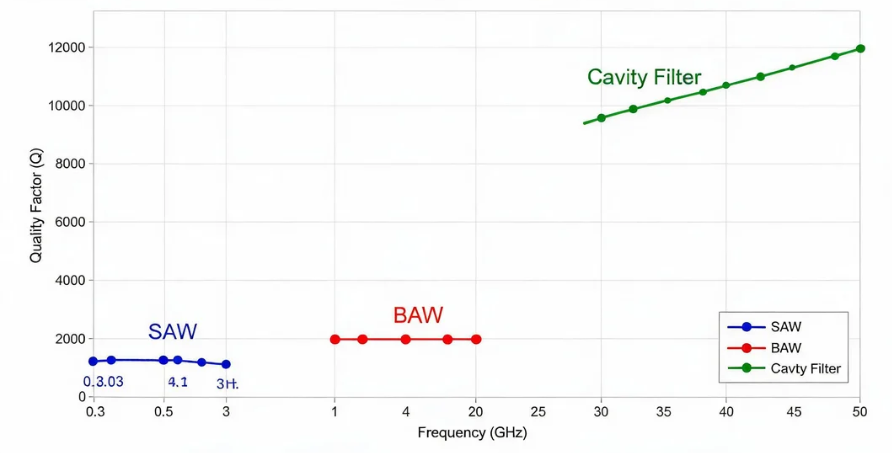
The Q value (quality factor) is something that determines how clean it is to cut across the line. The higher the Q value, the more ruthless the stopband suppression and the lower the insertion loss.
The cavity filter can achieve a Q value between 2000 and 10000 with eyes closed. This brings an extremely steep roll-off edge, and operators are not afraid of crosstalk even if they put adjacent frequency bands to death. They can go from 30 MHz all the way to 40 GHz (of course, when it comes to the millimeter wave band, its size will shrink a lot).
In contrast, the Q value of SAW filters mostly hovers between 500 and 800. They dominate the territory from 50 MHz to 2.5 GHz. But once it exceeds 2.5 GHz, the IDT comb spacing inside SAW will have to be nano-scale, and the yield will dive directly. (This is why smartphones have to ask BAW filters to come out of the mountain when they 1 to high frequencies).
Volume, Shape And Occupied Area
In consumer electronics, how much space you can move directly determines what components you can use.
The SAW filter takes the SMD route. Take a 0.8mm x 0.6mm conventional package and you can cover hundreds of them on 1 coin. Just for this figure, it is definitely a well-deserved overlord in smartphones, wearable devices and mini IoT sensors.
Cavity filter that is pure pure “big guy. A 700 MHz cavity duplexer with full performance can catch up with a shoebox. Even the 5G ceramic cavity filter, which is now claimed to be small, has to take up 1 large boards and vertical space and can only be sent to work in base stations, distributed antenna systems (DAS) and those bulky military radio stations.
Insertion Loss And Temperature Drift.
Remember a word: for every 1 decibels lost, your amplifier will have to bleed more and contribute more.
The insertion loss of cavity filters is so low that it is almost negligible-often less than 0.5 dB in the passband. Its dead metal skeleton is extremely temperature resistant. Especially the kind of high-end goods made of Invar (1 a low expansion iron-nickel alloy), even if the heat wave is rolling, the center frequency will not move.
The SAW filter side is slightly inferior, and the insertion loss is generally 1.5 dB to 3.0 dB. What’s more, the ordinary SAW substrate temperature coefficient of frequency (TCF) is high. As soon as the equipment heats up, the substrate expands, the sound waves run slowly, and the center frequency naturally falls down. To be used in harsh environments, engineers can only bite the bullet and choose TC-SAW (temperature compensated SAW) to suppress drift, at the cost of slightly increasing the cost and thickness of the point.
Unit Price And Capacity Expansion
In the face of these two technologies, the budget of the procurement team is simply a world of difference.
The semiconductor factory can print millions of SAW filters like money every day on standard wafers. The amount of 1 running, a single cost directly hit 0.05 to 0.15 dollars. Although the mold is expensive, the marginal cost is infinitely close to zero.
What about the cavity filter, which was dug out by the machining master a little bit. Whether it is CNC lathe milling on aluminum block or silver plating after die casting, it is inevitable to physically assemble this ring, and finally it is necessary to turn screws by hand or mechanical arm to adjust frequency. It may only cost 20 yuan to buy a ready-made gadget. If you make a space-grade custom-made one, you can’t even hear a sound if you smash thousands of dollars into it.
Old Driver’s Guide to Avoidance: What Not Written in the Data Sheet
Practical experience can often take off the cloak of hypocrisy in data manuals. When comparing SAW and cavity filters, hardware architects are most likely to roll over in two big pits.
SAW’s Intermodulation Trap:
The insertion loss data given by the manufacturer are all measured at 25°C, which looks beautiful. Can you try stuffing it into a packed 4G/5G small base station? The ambient temperature soared to 85°C every minute. Ordinary SAW at this time not only frequency chaos, at high temperatures will produce a serious nonlinear effect. If your system is very strict about the adjacent channel leakage ratio (ACLR), in order to save money, use cheap SAW, and finally cause FCC or CE certification to be killed due to thermal detuning, it is too late to cry.
PIM (Passive Intermodulation) Traps For The Cavity:
The purchase cost a lot of money to get a low PIM gourmet cavity filter. As a result, the little brother who was working on the site shook his hand 1 and screwed it directly on an uneven mounting frame. This physical stress caused the aluminum chassis to undergo a slight deformation of less than 1mm. Boy, the internal silver-plated contacts are 1 out of position, the PIM performance instantly avalanches from -160 dBc to -110 dBc, and your receiver is directly overwhelmed by the noise floor. Listen to my 1 advice, when installing the cavity filter, don’t forget to specify the torque upper limit.
Common Quick Questions and Answers (PAA)
Can A SAW Filter Withstand 5W Of Power?
Absolutely not. As long as it is 1 over 2W(33 dBm), the miniature metal combs on most commercial SAW filter substrates on the market will melt, resulting in permanent scrap. If you encounter a 5W job, be honest and practical with ceramic or small cavity filters.
Why Do Base Stations Have To Use Cavities Instead Of SAW?
The transmission power of the macro base station goes up from 20W to 100W, and it also requires extremely low insertion loss (less than 1 dB) to play the signal further. In the face of this purgatory-level thermal load, it can maintain an extremely steep suppression curve. Except for the cavity filter, SAW is simply physically unbearable.
After 3 GHz, Who Will Take SAW’s Class?
In mobile devices, over 2.5 GHz is basically the stage for bulk acoustic waves (BAW) and film bulk acoustic resonators (FBAR). If it is a high-power infrastructure, the baton will be handed over to the ceramic dielectric cavity filter.
Do Cavity Filters Have To Be Manually Tuned?
Yes. Tuning screws are inserted into traditional metal cavities. Before leaving the factory, technicians or mechanical arms must be used to screw these screws one by one, so as to lock the center frequency and return loss index.
SAW And Cavity, Whose Q Value Is More Cattle?
On the Q value, the cavity filter can throw out several streets, often soaring above 5000, and the edge of the passband is as sharp as a knife. The Q value ceiling of SAW is about 800.
Are SAW Filters Really Much Cheaper Than Cavities?
As long as the quantity is large enough, the price of SAW is simply a dimensional reduction blow. With the wafer-level semiconductor mass production process, a single cost can be reduced to a few cents or even a few cents. On the other hand, cavity filters, because machining and manual testing are indispensable, hundreds or even thousands of pieces are normal.