 Neditek
High Efficiency RF And Microwave Solid State Power Amplifiers
A rack amplifier can meet its output-power target and still be a poor fit for a system if its electrical and thermal demands have not been checked. For high efficiency rf and microwave solid state power amplifiers, the practical starting point is a defined operating case: frequency span, required output at the load, signal mode, and the condition under which efficiency will be assessed. Without those details, “high efficiency” is a claim that is difficult to compare.
Start With The Required RF Performance
Frequency coverage, output power, and gain should be read together. Neditek’s solid-state power amplifier range includes 0.08–1 GHz units rated from 100 to 300 W, 8–12 GHz units rated from 100 to 1,500 W, and higher-frequency options extending to 75–110 GHz at lower listed output powers. These are different design choices, not interchangeable wattage options.
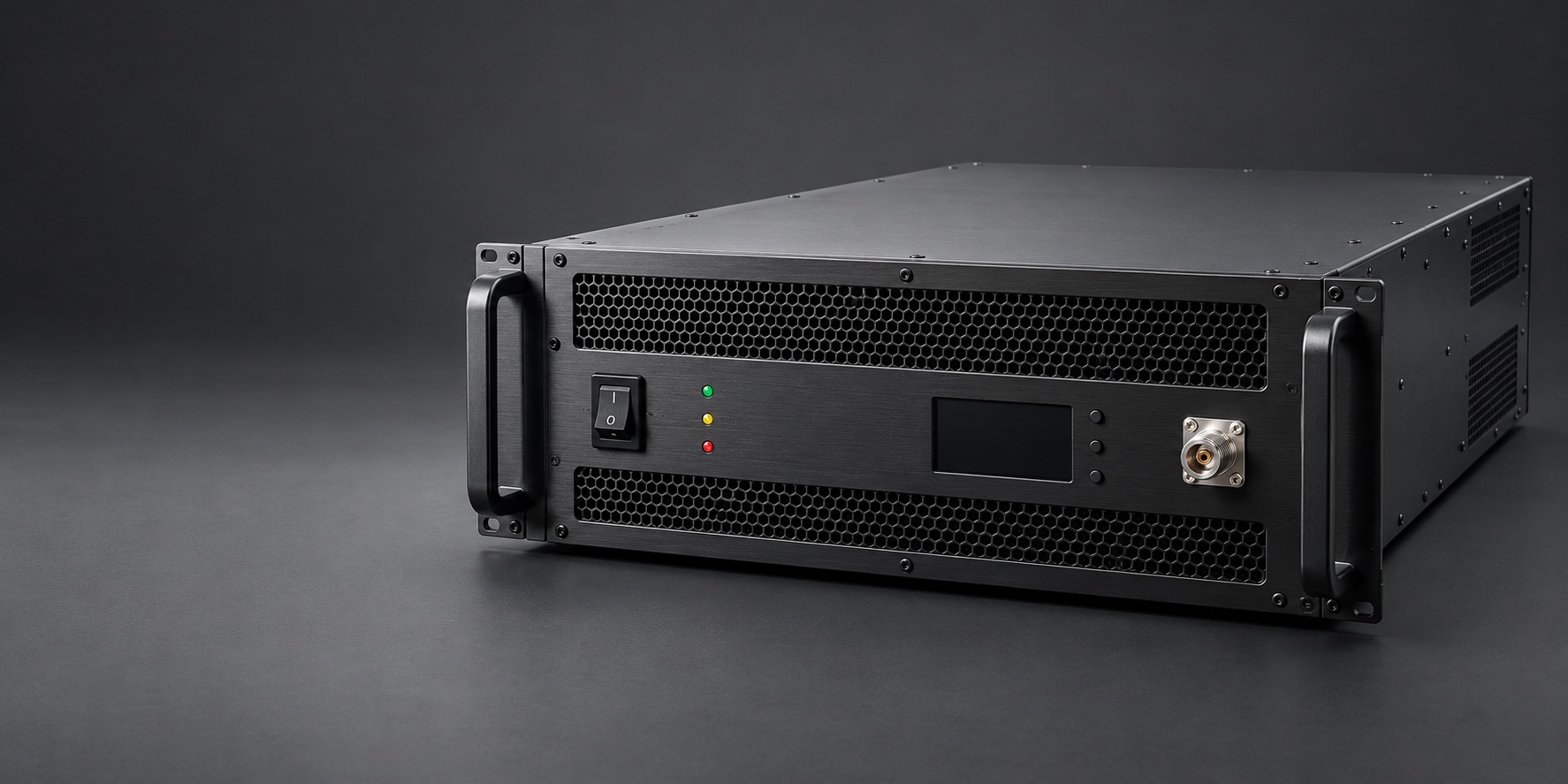
For a concrete comparison, the 8–12 GHz NDPM020023 is listed at 1,500 W output power and 62 dB gain in a 6U by 600 mm package. The NDPM020024 covers the same band at 800 W and 59 dB gain in a 4U by 600 mm package. If the system needs 800 W rather than 1,500 W, the second model is a relevant candidate because its band and stated power match the requirement and its rack height is lower. That comparison does not establish which unit is more electrically efficient. The listed amplifier specifications do not provide a complete efficiency value for either model.
What An Efficiency Number Must Describe
Efficiency should be tied to an operating point. Ask for the RF output, input drive, DC input, frequency, and signal mode used to obtain a quoted result. If the application runs below maximum power, ask for data at that actual output level as well. This lets the engineer compare the operating condition that matters, rather than a favorable number measured somewhere else on the device’s range.
It also matters whether the figure belongs to a semiconductor device or a finished amplifier. Neditek’s RF component selection guide reports power-added efficiency, or PAE, for individual GaN power amplifiers. For example, NDNC010222 is listed for 2.7–3.5 GHz with 60% PAE, while NDNC010052 is listed for 4–6 GHz with 47% PAE. Those entries describe component-level devices under their own listed conditions. They cannot be used as efficiency specifications for the rack-mounted NDPM units. A complete amplifier includes more than its active device, so its performance needs to be assessed at the assembly level.
Match The Operating Mode To The Application
The system requirement should say whether power is continuous or pulsed, and where the amplifier must operate within its band. A broad frequency range can be attractive, but the useful question is whether the required power and gain are available at the frequencies the system actually uses. A single headline value cannot answer that for every point in a wide span.
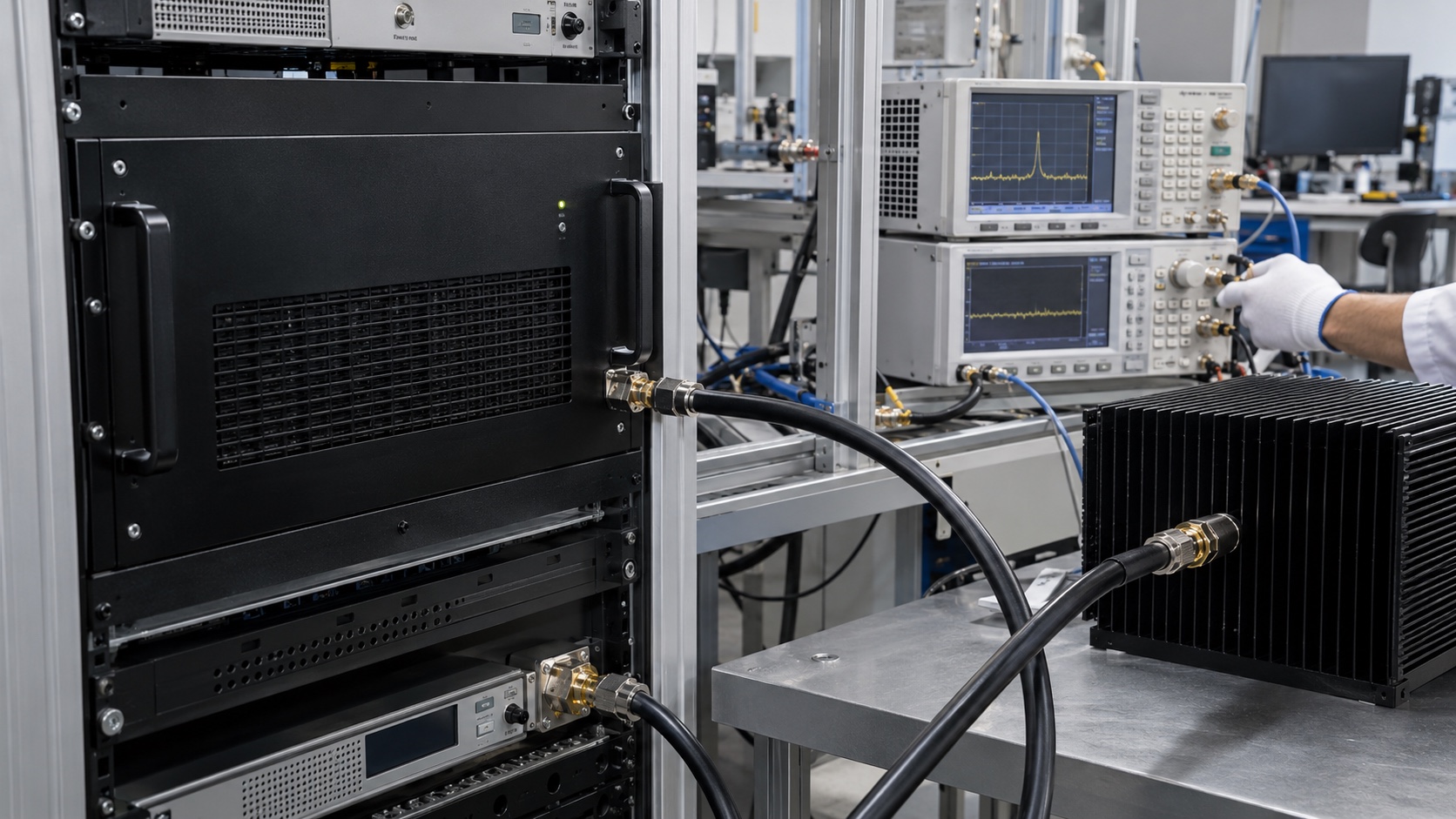
The component guide makes operating mode explicit for many GaN entries, using CW, pulsed, or combined PL/CW designations. That is a useful reminder when discussing a complete amplifier: request performance under the intended mode, rather than assuming a result from another duty condition will carry across. For the rack units, confirm the relevant mode and test conditions with the supplier before committing to a design.
Account For The Full Installation
Mechanical fit is part of selection, especially when higher output power changes the rack plan. The listed NDPM range uses 4U or 6U packages with a stated 600 mm depth. Allow for that envelope when planning the rack and verify the installation details for the chosen unit. The model table alone does not specify the complete cooling arrangement, electrical input requirement, or every interface. Ask for those details alongside the performance data so that the proposed unit can be assessed in the intended equipment layout.
A useful supplier discussion can be short and specific. State the frequency band, minimum RF output at the operating point, available drive level, signal mode, rack limits, and the efficiency measure you need. Then ask for measured results and test conditions for the candidate amplifier, including any relevant thermal and electrical input information. This approach makes it easier to compare two models on the same basis and avoids treating a component PAE value or a peak output rating as a whole-system answer.
The right amplifier is the one whose verified behavior fits the actual job. Neditek’s catalog provides a starting shortlist by band, output power, gain, and chassis size; an efficiency decision follows from measured data for the complete unit at the intended operating point.